
Despite increased competition from alternative alcoholic beverages and substances, sales within the nation’s distilleries industry are forecast to grow at a 5.08% compounded annual rate from 2026 to 2030, faster than the growth of the overall economy.
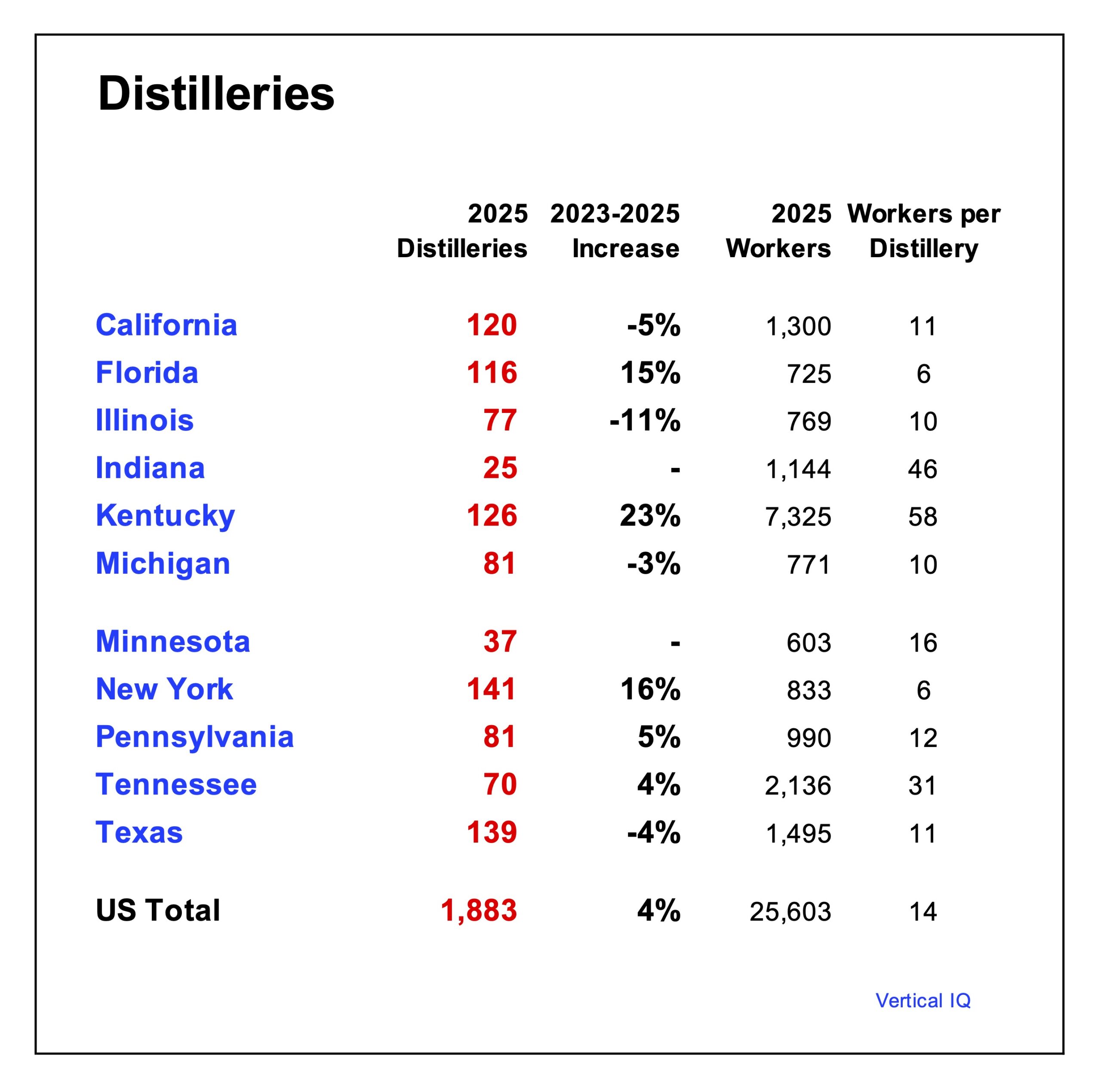
From 2020 to 2025, the number of U.S. distilleries jumped from 1,300 to 1,900. This increase didn’t come from expansion of major brands like Jim Beam or Jack Daniels but rather from small craft producers with mainly local products. When it comes to distillery products, 96% is whisky, while brandy, rum, gin and vodka account for the rest.
Whisky production is concentrated in Kentucky, where the average number of workers per distillery is 58. However, the largest number of distilleries (141) is in New York State, with an average workforce of just six people per employer.
There are ‘still’ industry challenges
Whisky distillation technology is simple, and the equipment required for a small operation is relatively inexpensive, but state and federal regulations for commercial operations are complicated.
Other than long production cycles and the seasonality of sales, the biggest problem for many small operators is getting their product out to consumers. Distribution can be hampered both by state laws that require products to move through authorized distributors and by federal restrictions on mail-order and interstate sales.
Balancing supply and demand
Making and selling whisky and other distillery products is a challenging business for smaller operators, but continues to be driven by consumer desire for new brands. U.S. whisky producers compete with products from England (scotch), Ireland, and Canada. Tariff wars in 2024 led to lower production but mainly affected the big operators.
Changing consumer tastes have reduced the number of adults who regularly drink alcohol, from 62% in 2023 to 54% in 2025, but most of the decrease was in the consumption of beer and wine, not hard liquor. Along a similar vein, a long-term problem faced by distilleries is that the U.S. population in general is growing at a very slow rate, so there will be fewer prospective customers.
During the last two years, some distillers in states that are mainly home to small operations (like California, Illinois, Michigan, and Texas) went out of business. In Florida, Kentucky, and New York, however, the number of operations continued to increase.
Want more industry insights like this? Vertical IQ’s library of more than 1,600 Industry Profiles and 3,400 local economic reports features analyst-written insights, financial benchmarks, local market data, and economic forecasts to help you better understand your clients and prospects. Learn more or start your free Vertical IQ trial today.
Main image credit: Daniel Norris, unsplash