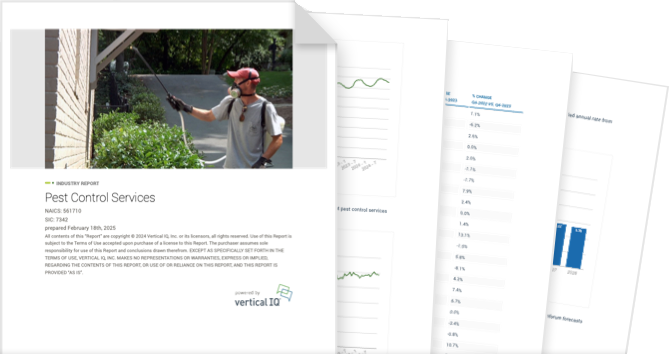
Pest Control Services
NAICS 561710
Unlock access to the full platform with more than 900 industry reports and local economic insights.
Get access to this Industry Profile including 18+ chapters and more than 50 pages of industry research.
Industry Summary
The 13,600 pest control services in the US exterminate and control the presence of unwanted creatures, such as insects, rodents, or other small animals. Companies may specialize in residential or non-residential services. Over 70% of industry revenue comes from residential services. Providers may also specialize in a particular industry, such as food manufacturing or health care.
Hazardous Substances
Pest control often involves the application of toxic chemicals that have the potential to harm humans, pets, plants, or the environment.
Government Regulation
Because pest control involves toxic substances, the EPA and state governments regulate various elements of operations, including licensing, record keeping, standards of application, training, and product registration.
Recent Developments
Sep 24, 2026 - Fuel Costs Pressure Pest Control Providers
- Record-high fuel costs are raising operating expenses for US pest control providers, where technicians depend on frequent vehicle travel between accounts, according to a Pest Control Technology report. The national average for regular gasoline reached $4.316 per gallon on September 14, after remaining above $4 throughout August. According to the 2026 State of Technology in Pest Management survey, 43% of PMPs said higher gas prices moderately strained their business and 25% reported severe financial stress. In response, 44% would raise customer prices or add fuel surcharges, while 39% would focus on routing and fuel-efficiency improvements. Some operators are also shifting toward hybrids; one provider said hybrid vehicles cut fuel expenses by about 50%. Higher fuel costs are therefore likely to pressure margins and encourage pricing changes, route optimization, and more efficient fleets.
- Weakening consumer confidence signals a mixed outlook for US pest control providers, with many services essential but some preventive treatments that can be postponed. The University of Michigan’s September Consumer Sentiment Index fell 7.5% to 47.8. Current Economic Conditions slipped 1.9% to 50.9, while Consumer Expectations dropped 11.1% to 45.8, suggesting households may scrutinize discretionary service spending more closely. Separately, the Conference Board’s August Consumer Confidence Index edged down to 89.4. Its Present Situation Index rose to 121.2, indicating firmer near-term conditions, but the Expectations Index fell to 68.2. For pest control providers, weaker expectations could pressure optional recurring treatments and upgrades, while urgent infestations, structural pest problems, and health-related services should remain relatively resilient.
- Rollins' second-quarter results reflect a resilient but moderating US pest control services industry, with commercial and recurring services continuing to outperform while softer consumer demand weighs on residential growth. Revenue increased 7.9% year over year, driven by strong commercial pest control (up 8.6%) and termite and ancillary services (up 10.5%), but residential organic growth slowed to 3.6% as fewer consumers sought one-time treatments such as mosquito, rodent, and carpenter ant services. Management cited weather, affordability pressures, gas prices, and weaker consumer-initiated demand as contributing factors, prompting a reduction in its 2026 organic growth outlook to at least 6%. Even so, improving lead volumes in late June and July, strong customer retention, continued pricing power, and ongoing acquisition activity suggest the industry's long-term fundamentals remain healthy despite near-term pressure on residential demand.
- Expanding mosquito activity across the US could boost demand for pest control services as warmer temperatures, higher humidity, and increased rainfall extend mosquito seasons into new regions, according to the latest Terminix data reported by Pest Control Technology. Terminix reported that mosquito pressure is spreading beyond traditional Southern markets, with Northeastern and Midwestern cities such as New York, Boston, Detroit, and Philadelphia seeing sharp increases in infestations. New York City ranked as the nation’s most mosquito-infested city for the first time in 2026. The trend creates growth opportunities for pest control companies through higher residential and commercial demand for mosquito treatments, seasonal prevention programs, and public-health-related services. Longer and less predictable mosquito seasons may also support recurring revenue and geographic expansion opportunities for pest control providers nationwide.
Industry Revenue
Pest Control Services

Industry Structure
Industry size & Structure
The average pest control services provider operates out of a single location, employs 11 workers, and generates $1.6 million annually.
- The pest control services industry consists of about 13,600 companies that employ about 153,500 workers and generate about $21.5 billion annually.
- The industry is concentrated at the top and fragmented at the bottom; the top four firms account for about 30% of industry sales. The majority of pest control service providers are small, independent companies or franchises.
- Large companies include Rollins (Orkin) and Rentokil (Terminix).
Industry Forecast
Industry Forecast
Pest Control Services Industry Growth

Vertical IQ Industry Report
For anyone actively digging deeper into a specific industry.

50+ pages of timely industry insights

18+ chapters

PDF delivered to your inbox